


Menu


Posted Nov 17, 2026 by Ren Lee
Q&A with inee, the Creator of Love Bullet
Cupids, guns, and heart-shaped bullet holes: to those familiar with this title's iconic visuals, Love Bullet really needs no introduction. If the illustrations didn't draw you in, the premise certainly did: it follows a group of Cupids, girls who died prematurely and without falling in love, all fighting to earn enough karma to make their way back to the land of the living. It's a synopsis that would fit right in with the early 2000's anime classics we know and love, promising excellent fight scenes, an eclectic cast, and a deep emotional core - which might sometimes take you by surprise.
Volume 1 dropped in December 2025. Meaning, it's been nearly a calendar year since then...and fret not, for Volume 2 of Love Bullet is here! And, in celebration of its highly-anticipated release, we here at Yen Press had the chance to speak with the mind behind the Girls Love hit, inee.
Read on to learn more about inee's inspirations and aspirations, her favorite parts of Love Bullet, and a glimpse into her creative process! And, of course, check out Love Bullet, Vol. 2, which is available now.
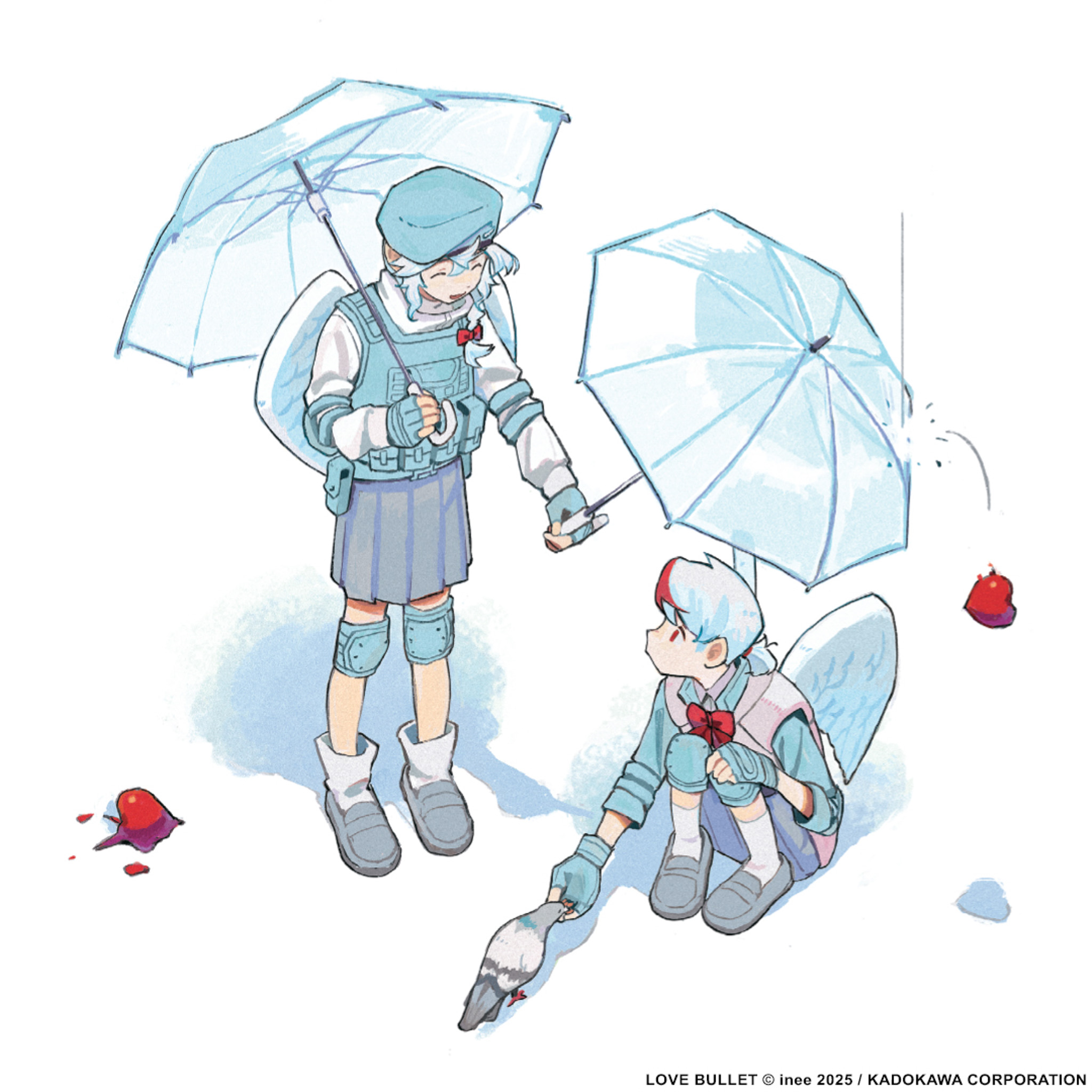
In the latest volume of Love Bullet, you set up what promises to be a much longer arc involving Ena and her life before she became a Cupid. The arc also seems to have a lot more to do with bullying and reconciliation than our first arc with Koharu in Volume 1. What was your thought process behind this direction? Why Ena in particular?
Love Bullet was always planned to be a character-driven story that slowly builds onto the world of Cupids and Koharu’s journey with each successive arc. It’s as much a story about humanity as it is about Cupids, so it was a natural decision to include interpersonal conflicts that aren’t directly centered on romantic love.
The four Cupids that make up the main cast of Love Bullet will each get their time in the spotlight–Ena just happens to be second in line!
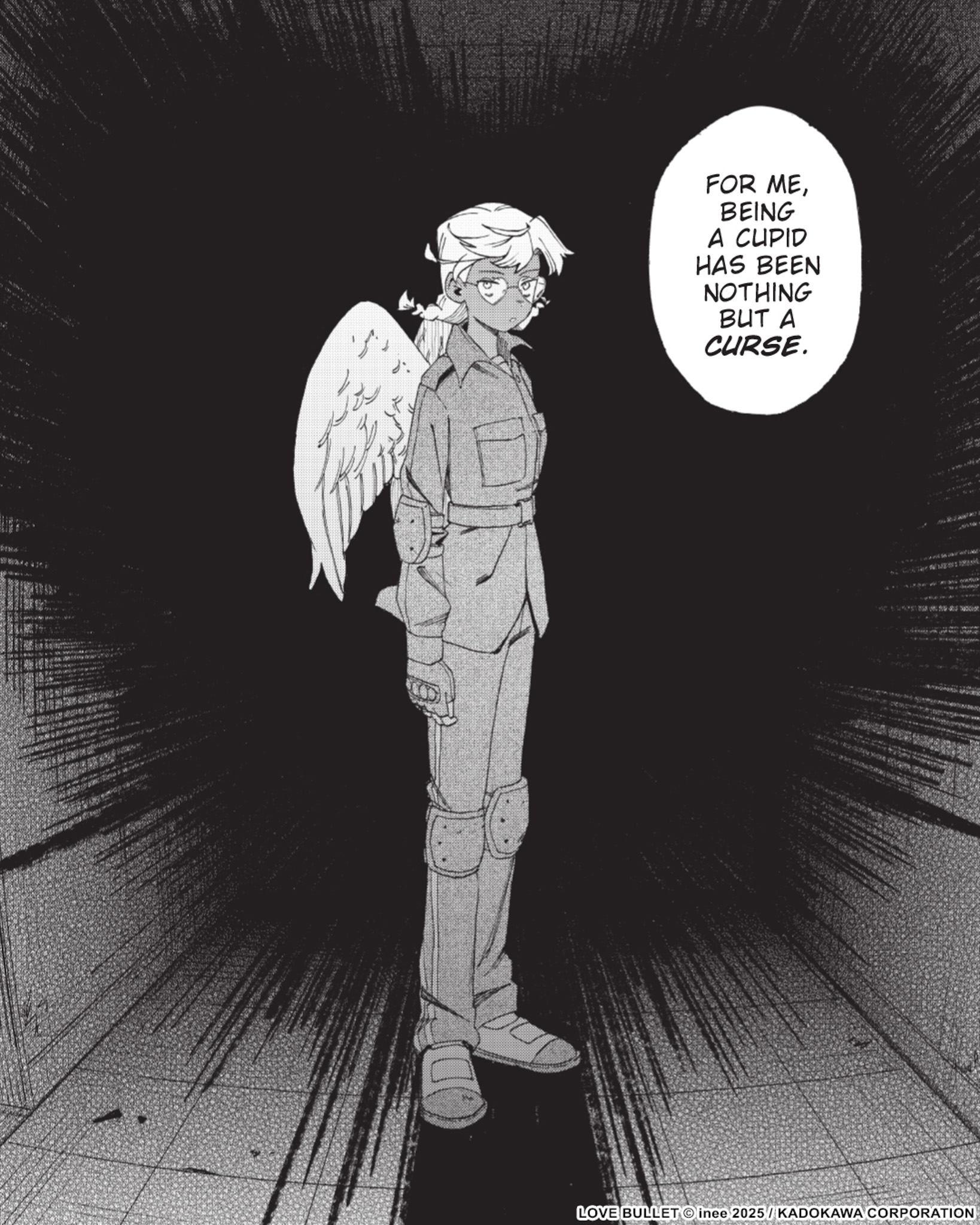
Love Bullet is a story that pulls together a lot of different thematic throughlines: grief, love, and growing up are a few that come to mind. Were there specific themes you were hoping to tease out of the narrative?
I wanted to highlight the importance of all forms of love that can be part of the human experience. The premise of Love Bullet originated from a character design, so when expanding the character concept of “a Cupid character that uses guns” into an actual story, I thought a lot about what kind of story I could tell with the premise. Once I thought of the idea of Cupids being “humans who should’ve died but got a second chance at life,” the themes of the story really fell into place. Rather than Cupids being these otherworldly beings completely removed from the human experience, making them humans that are only temporarily Cupids helped me define what kinds of themes I wanted to tackle with the narrative. So while the story will continue to be earnest in its portrayal of romantic love, it will also treat other types of love that humans experience - such as familial love and love between friends - with great importance.
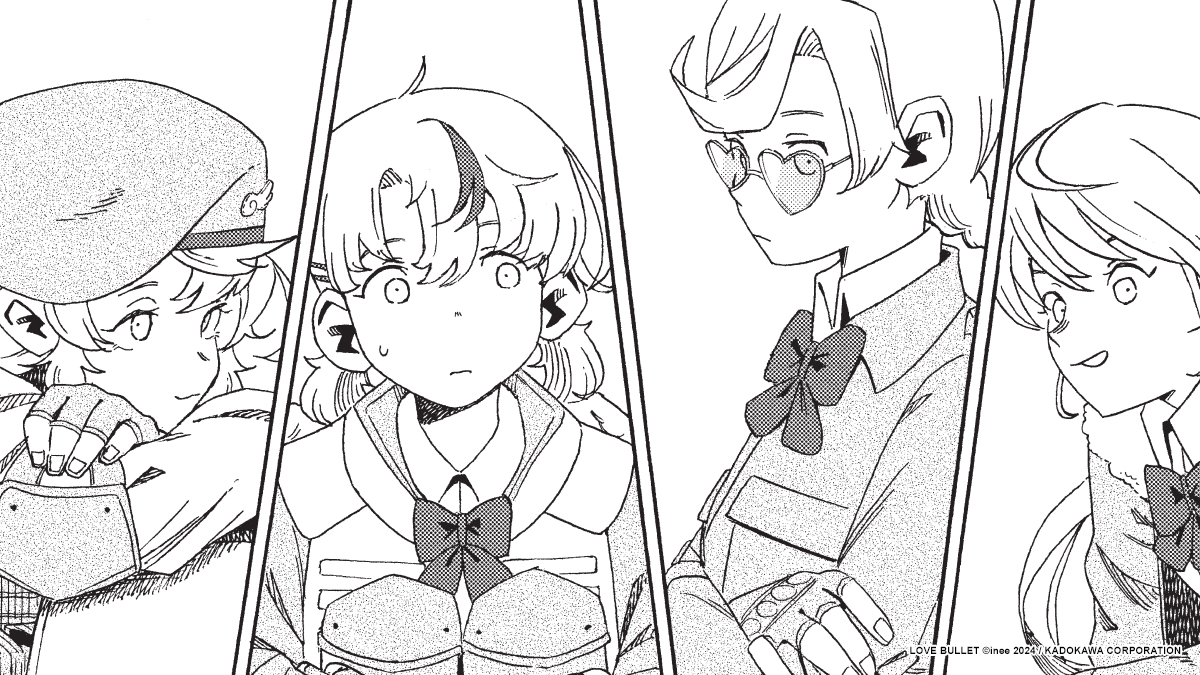
Who is your favorite of the four Cupids? Are you excited about telling anyone’s story in particular?
I like them all equally! I purposefully wrote and designed the four Cupids so that none of them would be “my favorite type of character.” I wanted to avoid the pitfall of having a clear favorite in the cast and giving them special attention in a way that’s detrimental to the narrative. I had a feeling I could easily make that mistake as a newbie author if I wasn’t careful, so I started all four Cupids as character archetypes that I didn’t feel strongly about in any way. Then I made their arcs as interesting as possible so that I’d care about them most in relation to the story over anything else.
This is also because the story was initially designed with an ensemble cast. Stories with a clear protagonist are much more favored in Japan, so I solidified Koharu as the main character early on during story planning (for the better!), but that initial vision probably influenced the decision to create the characters in a way that I would have no “preferred child.”
I’m excited to tell everyone’s stories, as they all give deeper insights to the characters that will make readers see a new side of them. Putting aside my own personal taste, I predict most readers will like Kanna’s the most.
Has the story changed dramatically from when you first started plotting it? What’s remained the same?
Not too much! I had to turn in a “series synopsis” of sorts when first pitching the story for serialization. It was a four-page outline going through the entire planned story. Overall, the basic story beats haven’t changed, though small details have. For example, very early on the plan was to have Koharu and Kanna take on several missions just as the two of them with Chiyo constantly butting in like a recurring villain. But due to how modern manga needs to captivate the audience immediately, I realized that I couldn’t afford to have the story go that slow, so that part of the synopsis was quickly scrapped.
Since then, I’ve written detailed synopses of each future volume of the story until the final one, and I don’t see it changing too much beyond expanding the details in some of the areas that are still very basic outlines.
Thankfully, I’ve been given some more breathing room on the pacing of the story, which is exciting since I can focus more on delivering the best story I can.
You mentioned in your author’s note in volume one that Love Bullet was “created by throwing together a bunch of different elements that [you’re] drawn to in fiction”. What other elements were you trying to pull in?
The elements I was referring to include hot-blooded action, an all-girls cast, romance, yuri, and character-driven stories.
I’m a big fan of anime that feature an all-girls cast, including slice of life, magical girl, and idol anime. While watching these shows, I often think to myself, “Everything in the story would make more sense if these two characters were unambiguously yuri!” (Disclaimer: This is my selfish opinion.)
That feeling is probably what compelled me to set up Love Bullet to be a lot like an action-packed, all-girls cast anime, but with a yuri cherry on top.
Love Bullet is referred to as a yuri by most of its fans – but romance between the main characters is something that explicitly cannot come about while they’re still Cupids. How does this restriction, in your opinion, affect Love Bullet’s relationship to the genre?
If we consider any given genre a rainbow and each color is a “different type of story” within that genre, I think it’s great when a genre has a wide range of colors rather than a more limited palette. Slice of life yuri, toxic yuri, tragic yuri, genre yuri–I love seeing different types of stories and don’t believe that any one type is superior to others, even if I may have my personal preferences. In that way, Love Bullet is just one color that makes up the yuri rainbow as a story where yuri isn’t the first genre in billing–maybe it can be a red slice of the rainbow?
To step into more of a “meta” discussion of the genre, I often see a wariness of stories that bill themselves as “yuri” but don’t end up featuring any yuri relationships in a meaningful way. Some people will go through the writing history of authors to see what track record they have of writing yuri, whether they can be trusted, and so on. Love Bullet has a bit of a unique setup and I can tell people don’t exactly know what its endpoint will be (and I don’t intend to spoil this!), which could cause concern for those that are more on the cautious side when approaching a yuri story that doesn’t strongly telegraph where it’s going narratively. To shed some light on my thoughts about this ongoing “meta” discussion, I was very intentional in making the first chapter’s “twist” a yuri couple and centering the first volume on Aki being in love with Koharu in a way that her attraction to girls cannot be ignored or censored. That’s all I can say for now!
Do you have a favorite part of the story so far? It can be a scene, storyline, or even a particular moment.
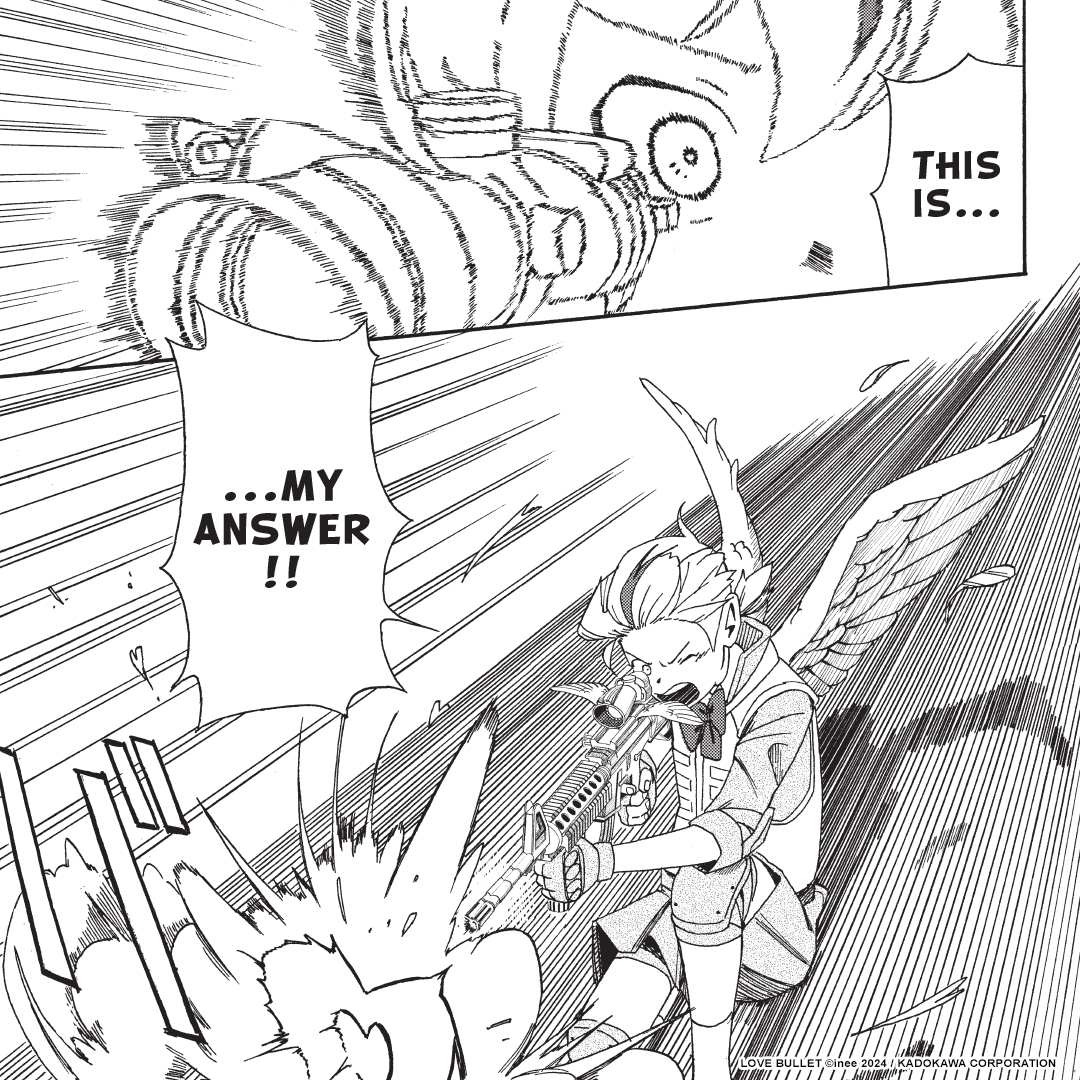
Pretty much all of Chapter 6, the last chapter of Volume 1! I remember finishing the draft for it at a friend’s place and thinking “This is it,” with a certainty I hadn’t felt before. It was the first time I turned in a name (storyboard)* and didn’t get back any major notes from my editor–before then I had multiple chapters where I had to redo half or more of the name because it wasn’t working narratively.
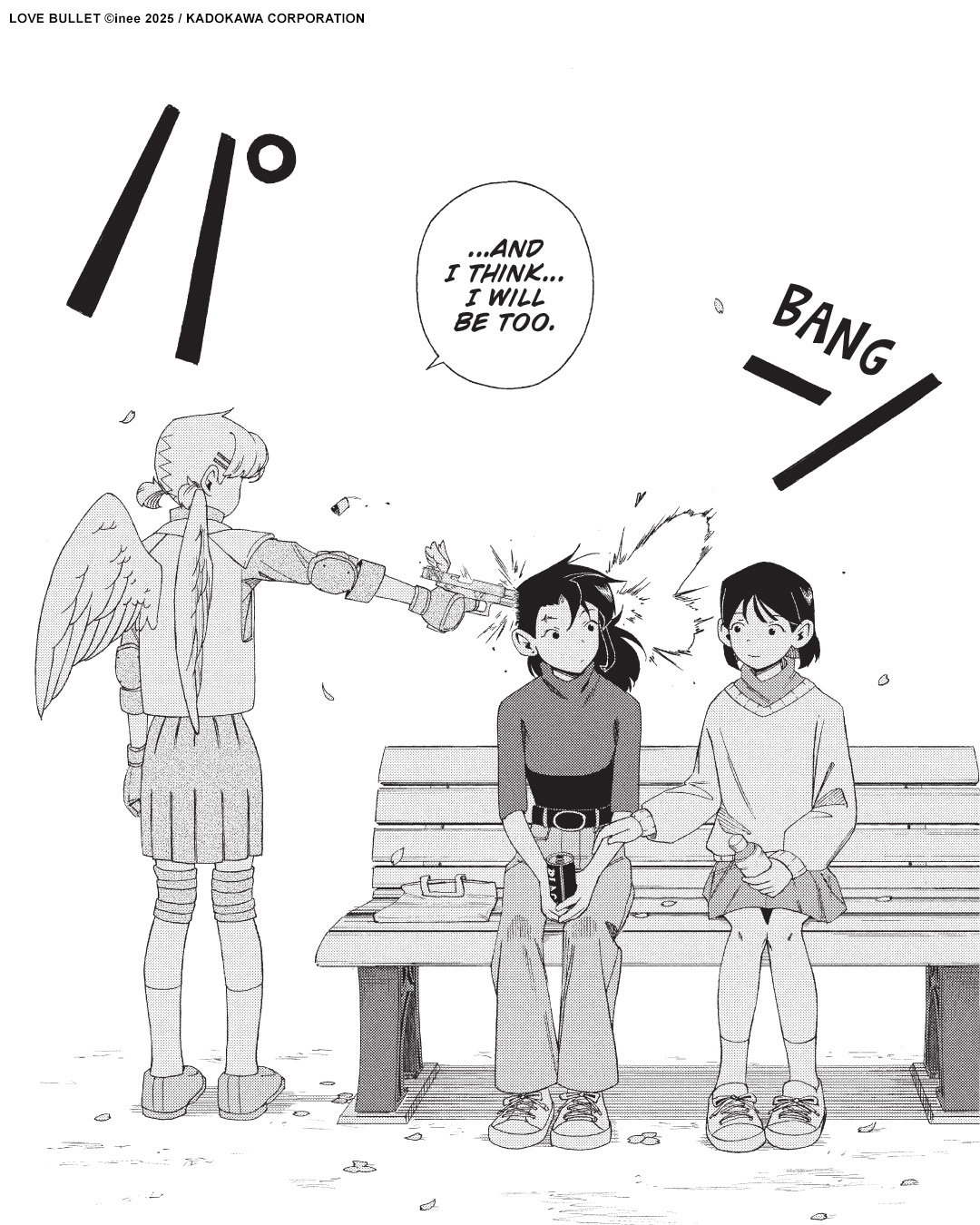
That being said, I really agonized over the art for the page where Koharu shoots Aki despite liking how Chapter 6 turned out overall. Sometimes I think about all of the different versions of that page I mulled over and wonder, “Did I choose the right one?", but it seems like the readers liked it quite a bit!
*"Name" (ネーム) is the Japanese term for a storyboard that contains the panel layout, dialogue, and rough sketches of the composition and character placement of a manga.
I’d like to dive a bit deeper into your creative process. When you set about working on a chapter, how do you start? What outside elements – music, surroundings, vibe – are important for your creative flow?
The general plot of each volume is already planned, so it starts with breaking down each new volume into 32-ish page chapters. Then I use the 起承転結 (Kishōtenketsu) method, which basically further breaks down the chapter into 4 acts, to get the outline to a point where I can begin working on the name.
My bread and butter before debuting as an author was short, light-hearted yuri stories. Love Bullet features many more emotional, dramatic, and action-packed moments in comparison, and these aspects of the story are much less intuitive for me to write. So I have a “love bullet vibes” playlist on Youtube to help me “lock in” when writing or drawing chapters that contain those aspects. The playlist has different sections that are for “emotional moments” and “hot-blooded fight scenes” as well as specific songs that represent each character, so I start the playlist in an area that corresponds to what I need at the moment.
(Sorry, that playlist won’t be going public anytime soon…)
What stories inspired you? Is there one in particular that made you want to become a mangaka?
In elementary school, my dream job was to be a cartoonist. At the time, I was really into Garfield, so I was thinking something more along the lines of a newspaper strip cartoonist, but the progression from cartoonist to mangaka didn’t end up being a big departure from that original dream.
There isn’t one particular manga that made me want to become a mangaka since manga has always been my favorite medium of fiction over prose books, live action shows and movies, and animated shows.
In terms of which stories I use for inspiration for Love Bullet, the list goes on and on! I have my inspirations and references sorted into different categories based on how they apply to the story. For example, for the hand-to-hand action and gun fight sequences, I heavily reference manga such as Hajime no Ippo, Eyeshield 21, Naruto, Bleach, and Black Lagoon. But when I’m getting into the nitty-gritty of “gun-fu” choreography, I reference movies like John Wick, John Woo films, and The Matrix.
There are stories whose set up and execution serve as strong inspirations as well; in particular I really like stories that balance comedy, drama, and action while having a strong emotional core. In that way, stories like Spirit Circle, Zatch Bell, and Mob Psycho 100 are big influences on the narrative execution of Love Bullet. I’m also looking at manga like Hikaru no Go and Noragami in how they portray ghost/spirit-like characters with lingering regrets similar to those of the Cupids.
This isn’t even getting into paneling and artstyle–I’m serious when I say I could go on and on about my inspirations, so I’ll stop here!
As a story, Love Bullet shares some similarities with stories in the magical girl genre. Were there any that might have inspired elements of the story? Do you think you’d want to write your own take on magical girls one day?
I’m a huge magical girl fan, so there’s a lot from those types of stories that probably made it into Love Bullet without me even being conscious of it. I consider my love for magical girl stories and other all-girl cast anime the “soul” of Love Bullet, while my other interests and artistic inspirations are more visible on a surface level, some of which I mentioned in the prior question. Of course, Love Bullet’s not a magical girl series, but the way that the Cupid activities in the story serve as a vehicle for the interpersonal conflicts to play out is very in line with how magic and battles function in magical girl shows.
And I’d love to do a story about magical girls someday! I have one in my “story ideas” folder, but it’s really ambitious–I’d probably need to take at least a year to research and work out the details if I end up doing that one after Love Bullet.
You’ve cultivated a large social media following around Love Bullet, especially here in the States. Has that affected the way you’ve approached Love Bullet since then? Is there anything you’d like to say to the readers that have joined you since then?
When I first began preparing Love Bullet as a potential serialized story, I had no expectations that it would be liked by a wide audience. In fact, I considered it a very niche concept, as yuri isn’t a particularly large market and the genre blend I was going for felt a bit out there. So I remember my big goal was for the story to be well-received enough within the yuri niche for me to be able to tell the story in full while also making a livable wage. (In retrospect, both of those goals are quite difficult to reach regardless of which genre you’re writing in…)
So seeing it gain as much attention as it has so far has been a wonderful surprise! Receiving this much of a response from overseas was completely unexpected, so sometimes I’m talking to my editor and publisher and the vibe is, “Wow! This is great, but this is also unprecedented so we’re not sure what to make of this!”
It hasn’t really changed the way I approach Love Bullet as a story, but it has changed the way I approach promotional activities and marketing. The quality of a story is only one aspect of selling a story. We’re in a unique time where an author’s presence on social media can play a huge role in marketing a manga, so I’ve been taking that role more seriously after seeing how much of a difference it can make.
I’m always incredibly grateful to the readers who support the manga in any form. As an author, the best way I hope to repay that support is to continue writing a satisfying story for everyone to enjoy! Love Bullet is set up so that it only gets more interesting as it goes on, so I hope it becomes a more and more enjoyable read!
SHARE:



Get the latest news
You will never miss updates if you subscribe to our newsletter.